


Post-Hurricane Roof Inspection Florida: 5 Critical Signs
November 5, 2026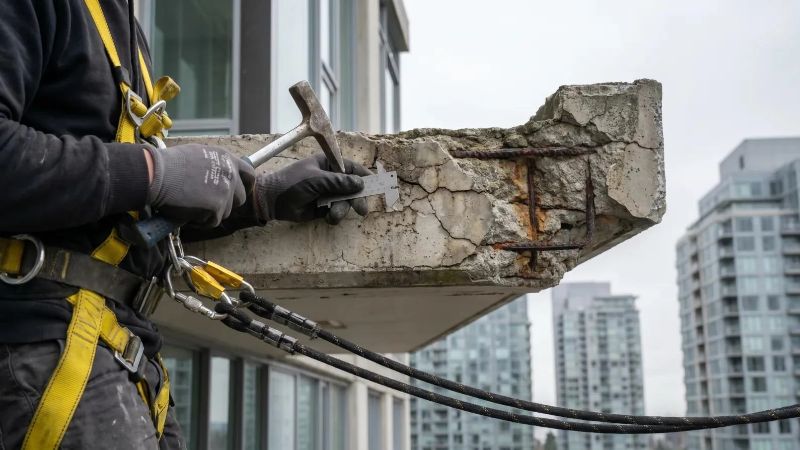
Understanding condo concrete restoration cost is essential for condominium association boards and property managers across South Florida. Budgeting for structural concrete repairs can be challenging because salt-laden ocean air, high humidity, intense solar exposure, and heavy rainfall accelerate concrete deterioration and internal rebar corrosion. These environmental conditions can significantly impact restoration requirements, project timelines, and overall building maintenance expenses.
As Florida’s mandatory milestone inspections and structural integrity reserve studies (SIRS) continue to take effect, many properties face required structural repairs. However, when property managers begin reviewing restoration proposals, they often encounter a major source of confusion: contractor estimates can vary dramatically from one bid to another.
Understanding how concrete restoration projects are estimated, and recognizing the specific variables that drive final project pricing, allows boards to establish realistic capital budgets, avoid unexpected change orders, and select qualified structural contractors.
Condo concrete restoration cost in South Florida is calculated using unit prices applied to the actual square footage or linear footage of damage, rather than a fixed lump-sum price. Final project totals depend heavily on repair depth, total quantity of exposed rebar, building access requirements (such as swing stages or scaffolding), engineering specifications, and necessary waterproofing.
The Core Concept: Allowance Quantities vs. Unit Pricing
The primary reason concrete restoration estimates vary so widely between contractors comes down to contract structure. Unlike a roof replacement or elevator modernization, where dimensions and equipment counts are static and fully measurable up front, concrete restoration is inherently exploratory.
When an engineer writes a scope of work for a restoration project, they perform initial visual inspections and chain-sounding to estimate deterioration levels. These baseline numbers are called allowance quantities.
Restoration contracts are awarded based on unit pricing. A contractor bids a specific dollar rate for individual tasks, such as:
- Per square foot of shallow concrete patch repair.
- Per square foot of deep overhead or slab edge repair.
- Per linear foot of rusted steel reinforcement cleaning or replacement.
- Per square foot of balcony traffic coating or waterproofing membrane application.
The total cost presented on a preliminary bid is simply a mathematical projection created by multiplying the contractor's unit rates by the engineer's initial allowance quantities. Once construction begins, workers chip away damaged concrete to expose healthy, un-corroded steel. The actual volume of deterioration uncovered during demo determines the final invoice.
This pricing structure is particularly important when evaluating condo concrete restoration cost because the initial estimate may differ significantly from the final amount once hidden deterioration is exposed.
If one contractor submits a low bid based on a minimal allowance estimate while another contractor calculates a higher bid using conservative, realistic quantities, the lower bid is not necessarily less expensive, it may simply carry higher exposure to cost increases during construction.
Primary Factors Influencing Concrete Restoration Pricing
Several interrelated building conditions, structural factors, and site logistics determine the final condo concrete restoration cost. Understanding these variables helps condominium associations anticipate project expenses and evaluate restoration proposals more accurately.
1. Severity and Depth of Concrete Deterioration
Concrete damage typically progresses through distinct stages:
- Minor Surface Scaling and Hairline Cracks: Superficial repairs addressed early involve localized patching or surface crack sealing, keeping per-square-foot restoration costs relatively low.
- Delamination and Spalling: As saltwater and moisture penetrate porous concrete, internal steel rebar oxidizes and expands. This internal pressure causes the surrounding concrete to crack and spall away from the structure. Repairing spalled sections requires removing concrete down to sound material, undercutting oxidized steel, and applying specialized repair mortars.
- Advanced Structural Failure: When moisture exposure is left unaddressed for years, steel rebar loses significant cross-sectional area. At this point, simple concrete patching is insufficient; section loss requires supplemental rebar installation, post-tension cable repairs, or full structural member reinforcement.
2. Reinforcing Steel Corrosion and Replacement Needs
Concrete removal is only half of the repair process. Once damaged concrete is chipped back, the exposed rebar must be evaluated by the structural engineer of record.
If corrosion is minor, the steel can be sandblasted or wire-brushed clean and treated with a protective anti-corrosion coating. However, if rebar has lost a significant percentage of its original diameter, new steel must be lap-spliced or mechanically coupled alongside the existing bars. The additional labor and material required for extensive rebar replacement represent a primary driver of cost increases during restoration.
3. Building Height, Elevation, and Site Accessibility
Rigging and access infrastructure make up a substantial portion of any high-rise restoration budget.
- Ground-Level and Low-Rise Work: Parking structures, walkways, and ground-floor amenities require minimal scaffolding or motorized lifts, keeping staging setup expenses contained.
- Mid-Rise and High-Rise Structures: Multi-story residential towers require specialized access solutions, including heavy-duty swing stages (suspended scaffolding), mast-climbers, or full perimeter staging systems. Erecting, rigging, moving, and maintaining certified rigging systems overhead adds logistical overhead that directly impacts overall project pricing.
4. Balcony Restoration and Waterproofing Requirements
Balconies are continuously exposed to rain and coastal wind. When restoration involves balcony decks and slab edges, several interconnected items affect the scope:
- Stucco and Edge Repairs: Removing blown stucco along fascia lines and repairing delaminated slab edges.
- Railings: Detaching, storing, or replacing code-compliant railing systems. If existing railings must be removed to execute perimeter slab repairs, re-anchoring them requires core-drilling and non-shrink epoxy grouting that aligns with current Florida Building Code wind-load standards.
- Waterproofing Membranes: Applying high-performance, elastomeric traffic coatings or waterproof membranes to balcony decks. Proper waterproofing is critical to prevent water from penetrating the newly restored concrete slab, protecting the association's investment long-term.
5. Engineering Oversight, Permitting, and Testing
Professional concrete restoration projects in South Florida require certified engineering administration. Budget estimates should account for non-construction soft costs, including:
- Threshold inspection fees and engineering field reports.
- Municipal building permit fees.
- Specialized testing services, such as concrete core sampling, chloride ion testing, and pull-off strength verification.
What Determines Condo Concrete Restoration Cost Per Square Foot?
Condo concrete restoration cost per square foot varies depending on the extent of deterioration, repair depth, reinforcing steel condition, building height, and accessibility requirements. Surface-level concrete repairs generally involve fewer labor and material requirements than deep structural repairs involving exposed or deteriorated rebar.
When evaluating restoration proposals, condominium associations should understand that a quoted square-foot rate does not necessarily represent the complete project expense. Additional costs may include suspended scaffolding, concrete demolition, reinforcing steel replacement, engineering inspections, permitting, balcony waterproofing, and specialized testing.
For this reason, property managers should request detailed, itemized proposals that separate estimated repair quantities from individual unit prices. This approach provides a more accurate basis for comparing contractor bids and establishing realistic capital improvement budgets.
Best Practices for Budgeting and Managing Restoration Costs
Property managers and HOA board members can take specific, practical steps to control condo concrete restoration cost, maintain financial oversight, and reduce unexpected expenses before and during a restoration project.
- Commission a Thorough Pre-Bid Engineering Survey: Never solicit contractor bids based strictly on a visual walk-through. A comprehensive engineering evaluation, incorporating chain-sounding, sounding hammer passes, and targeted exploratory openings, provides realistic initial allowance quantities, narrowing the gap between preliminary estimates and final project invoices.
- Establish a Dedicated Contingency Fund: Because concrete restoration contracts rely on unit pricing for uncovered quantities, associations should maintain an active project contingency reserve of 15% to 25% above the base contract figure. This buffer absorbs hidden structural deterioration discovered once chipping commences without interrupting project progress.
- Standardize the Bid Form: Require all bidding contractors to submit proposals using identical line-item unit rates based on the engineer's exact specification package. Standardizing unit price schedules allows the board to compare labor and material rates objectively, rather than relying on total projected dollar values that may be built on varying quantity assumptions. Comparing standardized unit rates also gives associations a clearer understanding of the factors influencing condo concrete restoration cost across competing proposals.
- Schedule Routine Maintenance Early: Addressing early warning signs—such as minor rust staining, hairline stucco cracking, or failing sealant joints, prevents water from reaching embedded steel, avoiding costly, wide-scale structural remediation in future years.
Frequently Asked Questions
What factors affect condo concrete restoration cost in South Florida?
Condo concrete restoration cost depends on the severity of concrete deterioration, the amount of exposed or corroded reinforcing steel, building height, accessibility requirements, engineering specifications, and waterproofing needs. Projects involving extensive structural repairs generally require more labor, materials, and specialized equipment.
How much does concrete restoration cost per square foot?
Concrete restoration cost per square foot varies depending on the type and depth of damage, repair materials, labor requirements, and site accessibility. Surface patching typically requires fewer resources than deep structural repairs involving reinforcing steel replacement. A detailed engineering assessment is necessary to establish project-specific pricing.
Why do condo concrete restoration estimates differ between contractors?
Contractor estimates often differ because of variations in estimated repair quantities, unit pricing, labor costs, equipment requirements, and project assumptions. Comparing itemized proposals based on identical engineering specifications helps associations evaluate bids more accurately.
Does balcony waterproofing increase concrete restoration costs?
Yes. Balcony waterproofing adds material and labor expenses to a restoration project. However, applying appropriate waterproofing membranes or traffic coatings helps protect repaired concrete against moisture intrusion, reducing the risk of premature deterioration.
Navigating complex structural repairs requires clear communication, precise planning, and experienced engineering execution. By focusing on detailed scope development, standardized unit pricing, and proactive building maintenance, condominium boards and property managers can protect their property’s structural integrity while maintaining control over capital budgets.
Request a Concrete Restoration Project Evaluation
Contact our team today to request a Concrete Restoration Project Evaluation for your building.